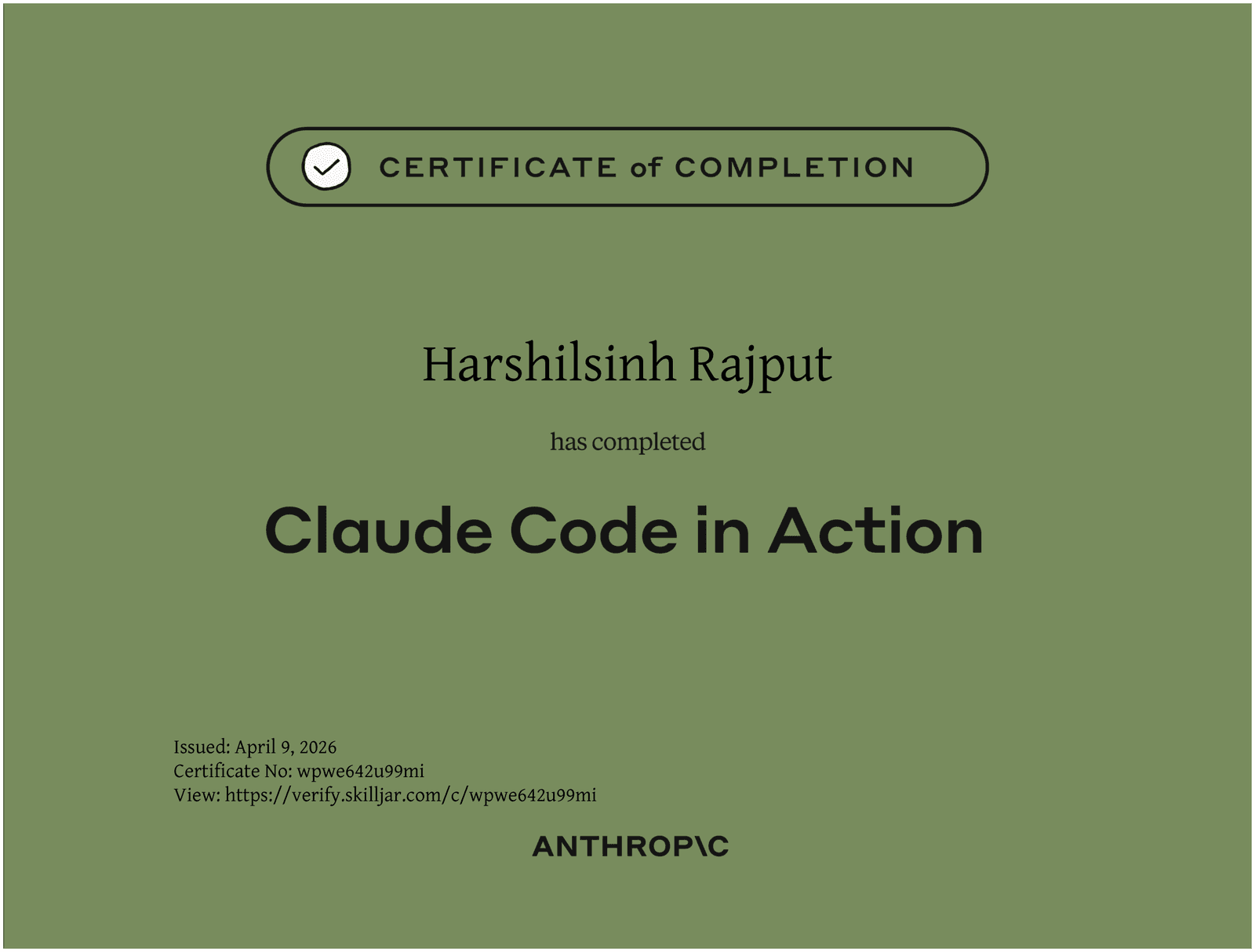
Claude Code in Action
An applied, project-based course on running Claude Code across real engineering workflows — multi-file changes, subagents, custom tooling, and verifying work end-to-end instead of trusting the first diff.
Overview
Where the 101 course covers the mechanics, this one is about using Claude Code on work that looks like an actual job: refactors that touch a codebase it hasn't seen before, delegating research to subagents without derailing the main conversation, building repeatable custom commands, and — the part I lean on most — treating 'the diff looks right' as a hypothesis to verify, not a conclusion.
What I Learned
- Directing multi-file refactors and tracing bugs across an unfamiliar codebase without losing control of the change's scope
- Using subagents to parallelize research (e.g. "where is X used across the repo") without polluting the main conversation's context window
- Building and reusing custom slash commands / skills for workflows I run often, instead of re-explaining them every session
- Automating verification — actually running the dev server, hitting the changed route, or screenshotting the UI — instead of trusting a diff that merely looks plausible
- Diagnosing issues empirically: instrumenting the running app (headless browser, computed styles, network requests) rather than guessing from source alone
- Working with MCP-connected tools and external services safely, with a clear sense of what data crosses that boundary
How I'm Using It in Real Development
On this portfolio, I used exactly this workflow to track down a bug where an animated "tech orbit" UI was rendering empty: instead of guessing, I drove a headless Chromium instance, inspected computed styles live, and found the real cause — a Tailwind CSS tree-shaking edge case compounded by a prefers-reduced-motion accessibility rule collapsing the animation
I now default to "verify, don't assume" for UI changes — spinning up the dev server and checking the actual rendered page (light/dark theme, mobile width, console errors) before calling anything done, rather than trusting that the code reads correctly
For generated assets like favicons and OG images, I have Claude Code reuse the project's own next/og pipeline instead of hand-rolling image generation, so output stays consistent with how the rest of the site already builds images
- Issuer
- Anthropic
- Issued
- April 9, 2026
- Certificate No.
- wpwe642u99mi